Ibn al-Haytham
Optics · 11th century
Scientist whose experiments on light, vision and the camera obscura shaped the history of optics.
A History of Photography
Told with silver, asphalt, mercury fumes and one very slow view from a window in Burgundy. Start by letting light into a dark room.
Light from the sky above the rooftops travels down, through a small hole in the wall…
…and light from the courtyard below travels up. The two paths cross at the hole.
Every point of the view does the same, so the whole picture arrives on the back wall upside down and back to front.
For two thousand years people could watch this picture, but nobody could keep it. This is how they learned to.
In the darkroom
Light. It is the same stuff as radio and X-rays, and only its wavelength is different. Drag along the strip. The coloured sliver is all your eyes get, and photography began inside it.
Light travels like a wave and lands like a hail of tiny packets, called photons. The shorter the wave, the more energy each photon carries: a blue photon has about one and a half times the punch of a red one.
That is the whole secret of the silver plate. A photon with enough energy knocks an electron loose inside a crystal of silver salt, and the electron helps turn silver into specks of metal. A red photon can't manage it. Bare silver salts are blind to red, which is why a darkroom can work by a red lamp, and why this part of the page is lit like one.
Because early plates saw mostly blue and ultraviolet, they didn't record the world the way you see it. Change the plate and look at the sky, the barn and the washing.
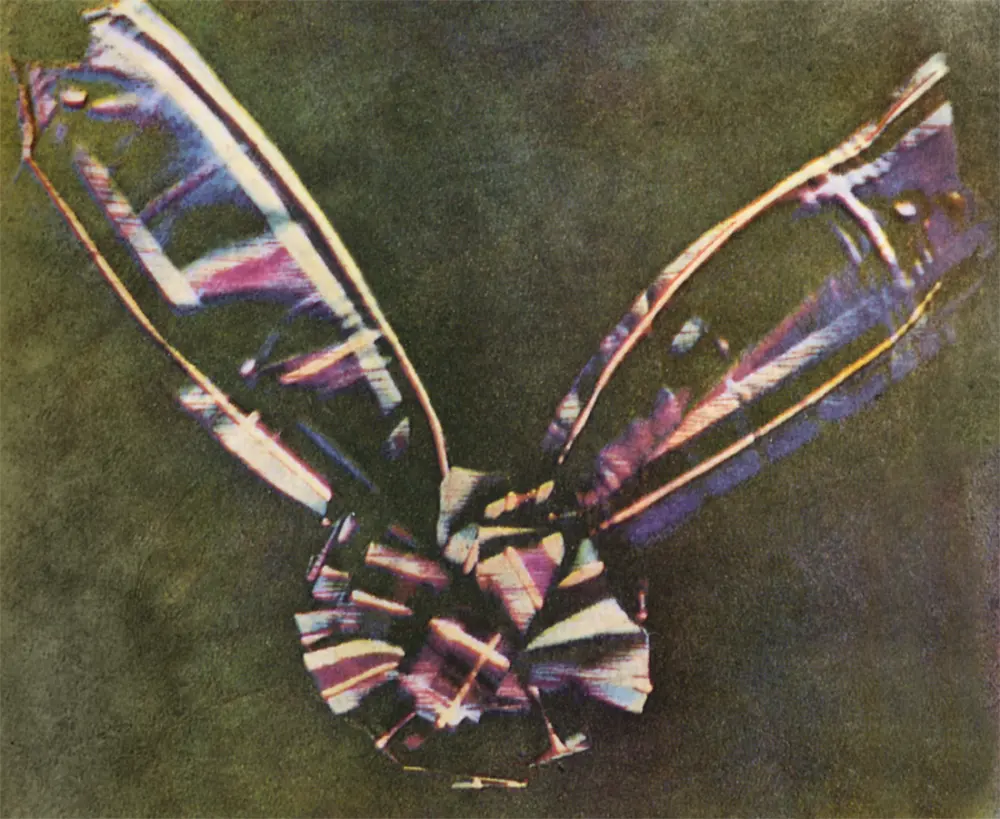
In 1861 the Edinburgh-born physicist James Clerk Maxwell showed the first colour photograph that lasted: a tartan ribbon, taken three times through red, green and blue filters, then projected back through the same three. The plates of the day barely responded to red, so it ought to have failed. A century later, researchers at Kodak worked out why it hadn't: the ribbon's red dyes also reflected ultraviolet, and the plate saw that instead.
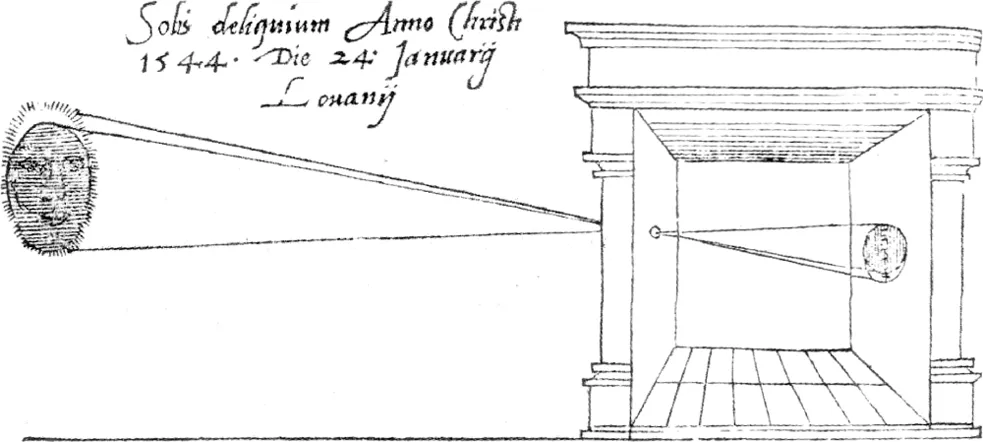
The camera was not invented by photography. For more than two thousand years, people studied how light could reproduce the visible world inside a dark space.
The camera obscura (Latin for "dark room") is a natural optical phenomenon. Light passing through a small opening travels in straight lines and forms an upside-down image on the opposite wall. A lens makes the image brighter and sharper.
The principle was described in the Chinese text associated with Mozi (5th–4th century BCE) and in the problems attributed to Aristotle, who noticed crescent-shaped images of a partially eclipsed sun cast through the gaps between leaves. The eleventh-century scholar Ibn al-Haytham (Alhazen), working in Cairo, investigated it systematically and used it to explain how light travels and how vision works.
Astronomers adopted the dark room as a safe way to watch the sun. In 1545 the Flemish mathematician Gemma Frisius published the first known illustration of one, showing the solar eclipse he had observed at Louvain on 24 January 1544.
From there the instrument grew. Gerolamo Cardano described fitting a glass disc, probably a lens, in 1550; Giambattista della Porta popularised the darkened room as a spectacle and drawing aid in Magia Naturalis (1558); Johannes Kepler gave it its Latin name and built a portable tent version. By the eighteenth century, box-sized camera obscuras with mirrors and ground-glass screens were common studio tools. The device could show an image; it could not keep one.
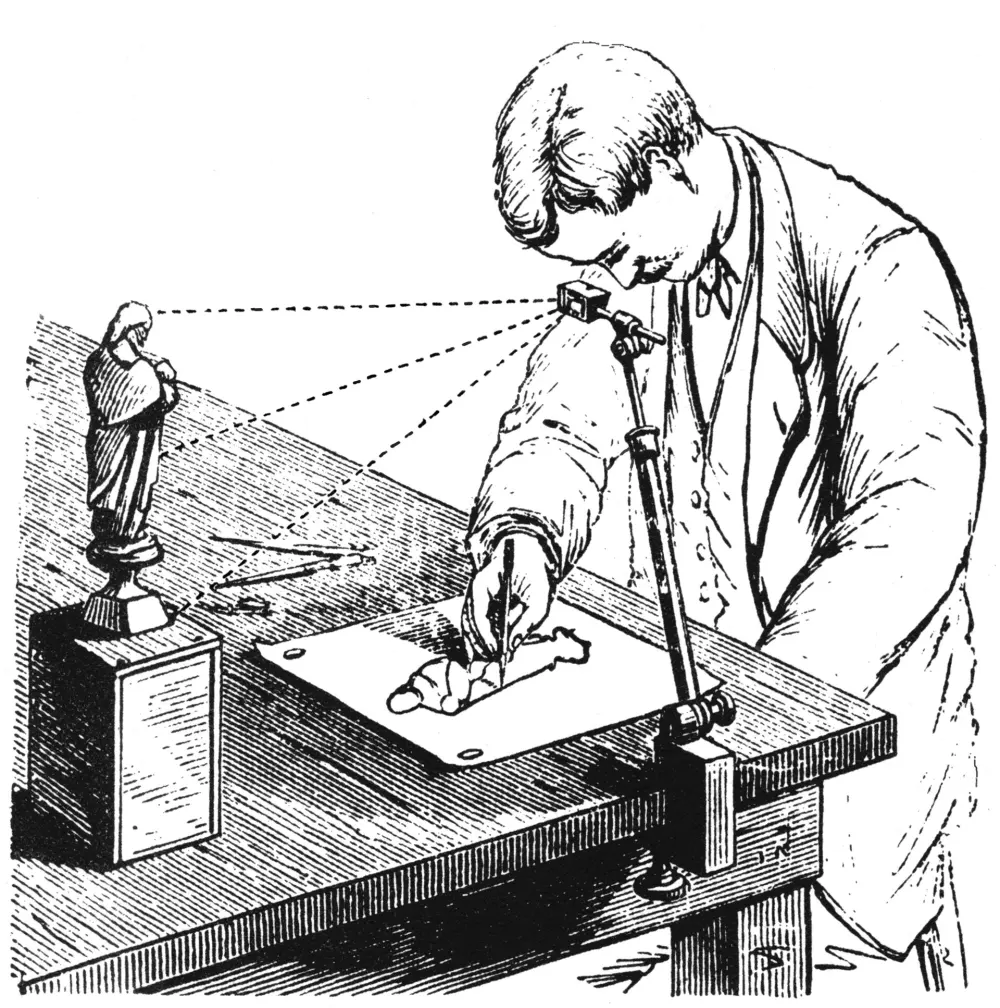
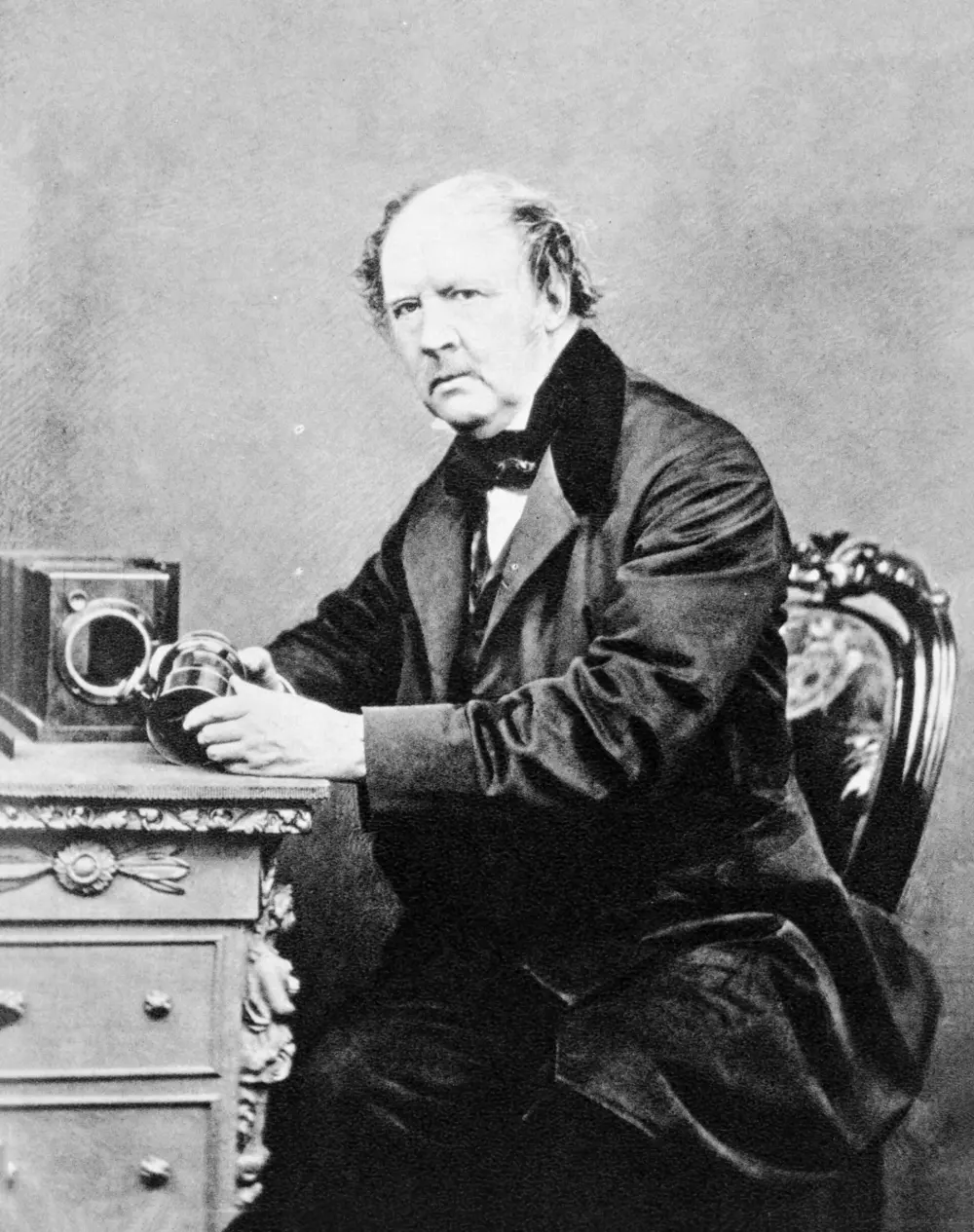
Patented by William Hyde Wollaston in 1806, the camera lucida ("light room") used a prism to make a subject appear superimposed on the paper beneath it. It was a drawing aid, not a camera: the artist traced what they saw. In October 1833, sketching on the shores of Lake Como, William Henry Fox Talbot found the results with one dispiriting. He later recalled thinking
"how charming it would be if it were possible to cause these natural images to imprint themselves durably, and remain fixed upon the paper!"Talbot, The Pencil of Nature, 1844
The frustration helped turn an old optical problem into a chemical one.
Improvements in spectacle-making, telescope design and precision grinding gradually produced brighter projection boxes. By the early nineteenth century the apparatus was ready. What was missing was a surface sensitive enough to record the image, and a way of stopping that surface from changing afterwards.
In the darkroom
Make a small hole in the wall of a dark room and the world outside appears on the opposite wall, upside down and back to front. Change the hole, the room and the subject to find out why.
Every point of the scene sends light out in all directions. The hole lets through only a thin bundle from each point. Light from the top of the flag has to travel downwards to pass through the hole, so it carries on downwards and lands low on the wall. Light from the grass travels upwards and lands high. The bundles cross at the hole.
The same happens sideways: light from the left of the scene crosses to the right. So the image is reversed in both directions at once, which amounts to turning it through 180°. Tap different points in the "Outside" view and follow where they land.
Each point of the scene doesn't arrive as a point, but as a small disc the shape of the hole. A bigger hole lets in more light but makes bigger, overlapping discs: brighter and blurrier. A smaller hole is sharper but dimmer, and below a certain size diffraction (light spreading out as it squeezes through a tiny gap) blurs it again. Every room has a best hole size.
Moving the wall back makes the picture bigger and dimmer; moving the subject closer makes it bigger. Your eye works the same way: in 1604 Kepler showed that the image on the retina is upside down, and the brain sorts it out.
In the darkroom
A lens solves the pinhole's dilemma: a wide opening and a sharp image, but only at one distance. A mirror turns the picture the right way up, though never quite the right way round.
A convex lens bends all the rays from one point of the subject so that they meet again at a single point behind it. Put the wall exactly there and the image is sharp, and as bright as the whole lens is wide. Move the wall and the meeting point falls in front of or behind it: blur. Near and far subjects come to a point at different depths (for a lens of focal length f, 1/f = 1/u + 1/v), which is why cameras have to be focused. Cardano was putting lenses in camera obscuras by 1550.
Portable drawing cameras of the 17th to 19th centuries put a mirror at 45° behind the lens and threw the image up onto ground glass on the top of the box, where it could be traced. Tick the mirror: the picture is now upright, but still reversed left to right, like a reflection.
A daguerreotype plate faces the lens in the camera, and afterwards we look at that same face. So the image is laterally reversed: shop signs read backwards, and a sitter's parting and buttons are on the wrong side. Some daguerreotypists fitted a mirror or prism in front of the lens to correct it.
Talbot's paper negatives were reversed too. But a negative is printed by laying it face-to-face on a fresh sheet, which reverses it a second time, so the prints come out the right way round. Try it in "Negative into positive" →
The breakthrough was not simply making a surface darken. It was learning to control the change: expose it, develop it and stop it.
Some silver compounds are photosensitive: light changes their chemical structure and produces dark metallic silver. In 1725–27 the German professor Johann Heinrich Schulze showed that a mixture of chalk and silver salts darkened where sunlight struck it. He cut letters out of paper, wrapped them around a bottle of the mixture and watched words appear. He proved the cause was light, not heat.
In 1777 the Swedish chemist Carl Wilhelm Scheele found that darkened silver chloride resisted ammonia, which dissolved the unaltered compound. It pointed to a way of stabilising an image by removing the sensitive material that light had not touched, though no one used it for decades.
Around 1800 Thomas Wedgwood, son of the potter, working with Humphry Davy, made shadow pictures of leaves, insect wings and painted glass on paper and white leather coated with silver nitrate. Davy published their results in 1802. The images could only be looked at briefly by candlelight; daylight darkened the whole sheet. They had made photographs, but could not fix them. (A leaf photogram once attributed to Wedgwood surfaced at auction in 2008; most scholars now think it is by Talbot.)
John Herschel supplied the crucial practical answer. In 1819 he had found that sodium thiosulfate (then called hyposulphite of soda, or "hypo") dissolves silver salts. When news of photography reached him in January 1839, he realised at once that hypo could wash away unexposed silver and make an image permanent. It is still the standard fixer. Herschel also gave the medium much of its vocabulary: photography, negative, positive and, later, snapshot.
In the darkroom
Talbot's prints, Daguerre's plates and the film in a 1990s point-and-shoot all depend on the same chemical tricks: light leaves a tiny trace in silver crystals, and the rest of the process makes that trace visible and permanent. Work through the steps, or skip one and see what goes wrong.
The light-sensitive materials are silver halides: silver combined with chlorine (Talbot's salted paper), iodine (Daguerre's plates, the calotype) or bromine (most gelatin films and papers from the 1870s). They form as tiny crystals, called grains, when a soluble silver salt meets a soluble halide. Bigger grains catch more light, which is why fast films look grainy.
Print-out papers simply darken in the sun until the image is visible. That needs minutes to hours. Develop-out processes stop after a fraction of a second, when the image is still invisible, and let chemistry do the rest.
After exposure, most of the sheet is still light-sensitive silver halide. Look at it in daylight and it carries on reacting, until the whole picture sinks into darkness. Wedgwood and Davy got this far in 1802 and no further. Herschel's hypo (sodium thiosulfate) turns the remaining silver halide into a soluble complex that washes out, leaving only the metallic silver of the image. Washing it out thoroughly matters too: leftover hypo slowly yellows and fades a print.
The result is a negative: dark where the light was. Turn it into a positive →
The first permanent photographs came out of printmaking. Niépce was not trying to make pictures for their own sake: he wanted light to engrave a plate that a press could print.
Joseph Nicéphore Niépce (1765–1833) was a gentleman inventor from Chalon-sur-Saône in Burgundy. With his brother Claude he had already built the Pyréolophore, one of the first internal combustion engines. In 1813 he caught the French craze for lithography, the new method of printing from drawings made in greasy ink on limestone. Niépce could not draw; his son Isidore made the designs. He began looking for a way to let light do the drawing instead.
His first camera experiments, in 1816, used paper coated with silver chloride. He made small negatives of the view from his workroom, which he called rétines, and sent descriptions to Claude. But he could not fix them, and he disliked that the tones were reversed.
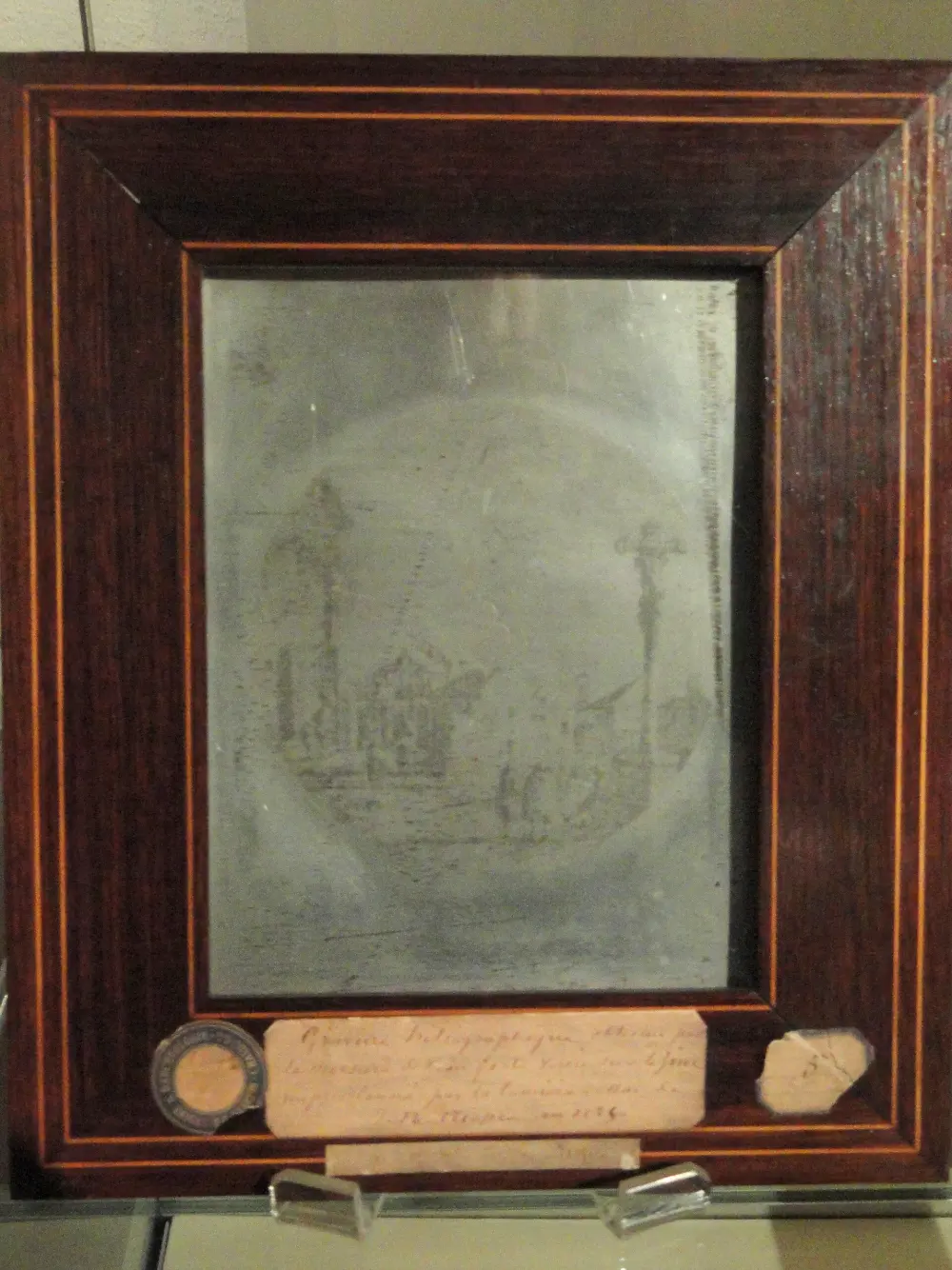
He then turned to a material printers already knew: bitumen of Judea, a natural asphalt used as an acid-resisting ground for etching. Bitumen hardens and becomes insoluble where light strikes it. Niépce coated plates of glass, stone, zinc, copper and pewter, laid an engraving made translucent with oil over them, and left them in the sun. Where the black lines of the print had shielded the bitumen, it stayed soft and could be washed away with oil of lavender and white petroleum, exposing bare metal. Acid then bit those lines into the plate, which could be inked and printed. He called the process heliography, sun-writing.
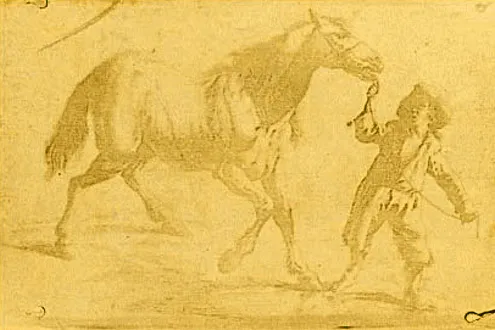
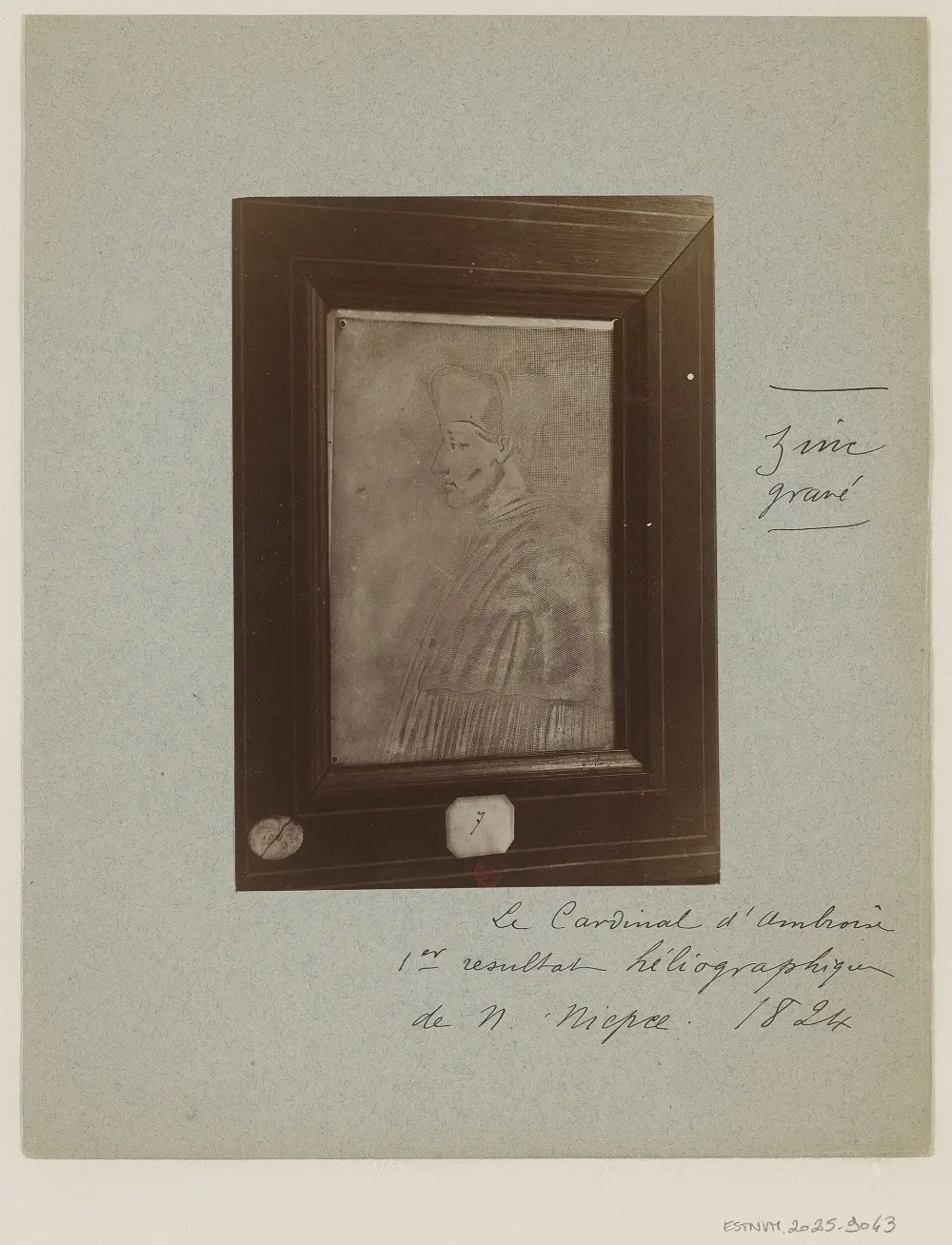
A first heliographic copy of a portrait of Pope Pius VII, made in 1822, was destroyed when he tried to print from it. The oldest that survive date from 1825: a print of a seventeenth-century Dutch etching of a boy leading a horse, and one of a woman at a spinning wheel. In 1826 he copied Isaac Briot's engraved portrait of Cardinal Georges d'Amboise; the plates were etched more deeply by the Paris engraver Augustin François Lemaître, and prints were pulled from them in 1827. They are the ancestors of photogravure, photolithography and every photomechanical printing method that followed.
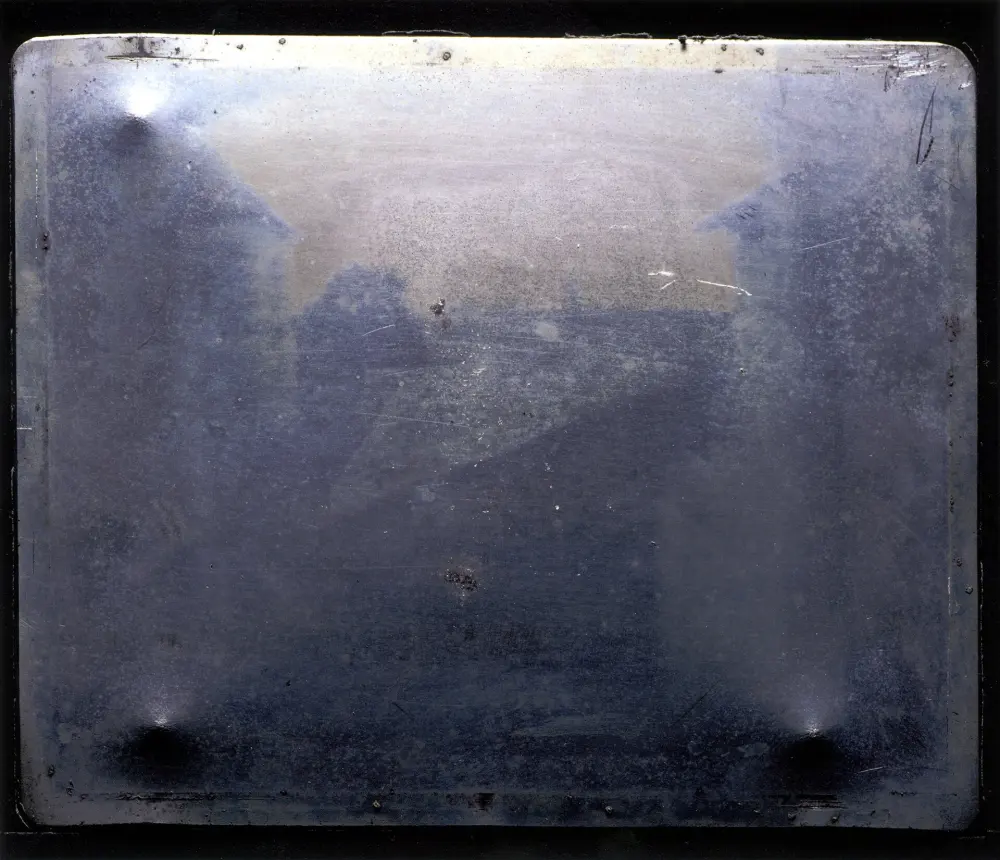
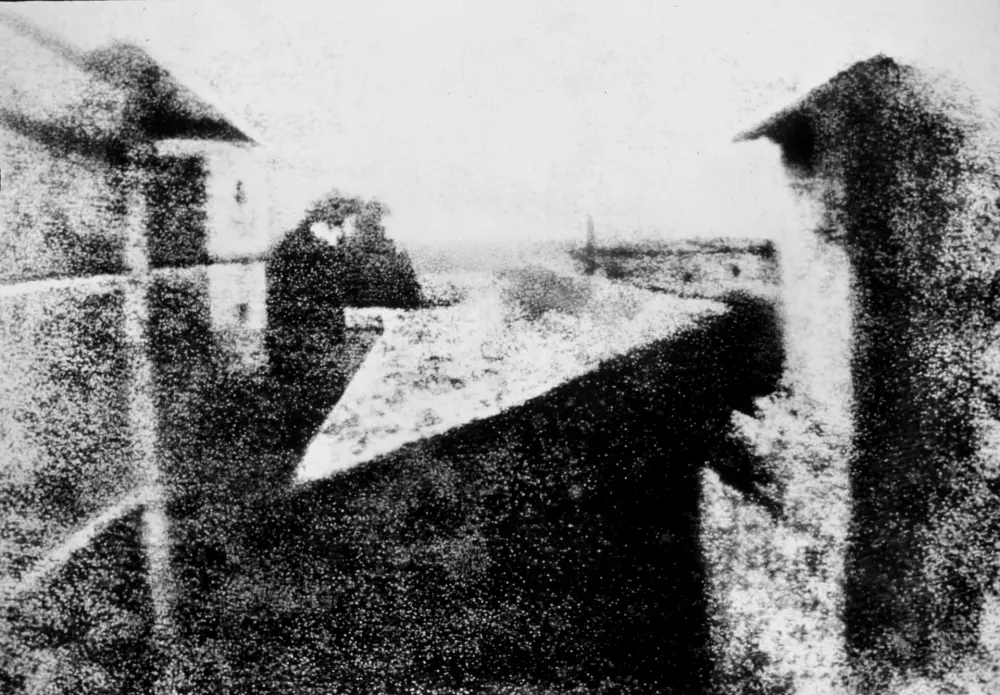
Niépce also put bitumen plates in a camera obscura, aiming at the courtyard below his upstairs workroom at Le Gras, his estate at Saint-Loup-de-Varennes. One pewter plate made in 1826 or 1827 survives. It shows a pigeon-house on the left, a pear tree, the sloping roof of a barn and another wing of the house on the right. The bitumen is so slow that the exposure took at least eight hours and may have lasted days; sunlight appears to strike both sides of the courtyard because the sun crossed the sky while the plate was exposed.
In 1827 Niépce travelled to Kew to visit his ailing brother and tried to present heliography to the Royal Society. Because he would not reveal the full method, the Society declined. He left the plate with the botanical artist Francis Bauer. It passed through private hands, vanished after 1905, and was tracked down in 1952 by the historian Helmut Gernsheim, who commissioned the enhanced reproduction that is usually printed. Since 1963 it has been at the Harry Ransom Center in Austin, Texas.
The original is hard to read: a mirror-like metal plate on which the image appears only at a raking angle. It is also extraordinary: a metal surface physically altered by light reflected from the world itself.
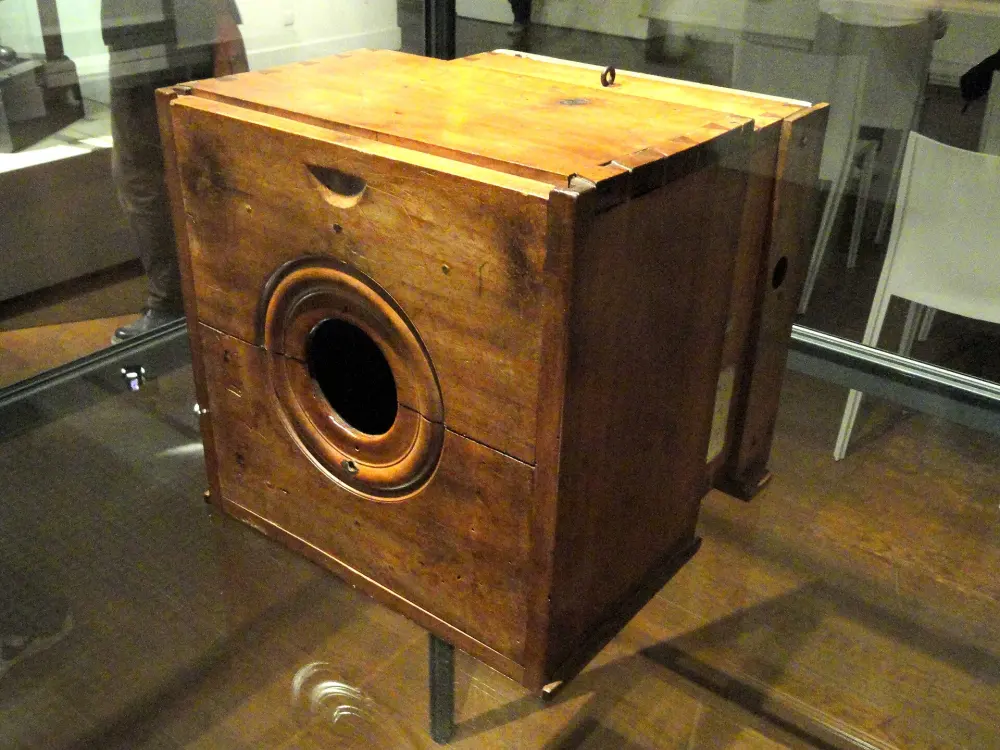
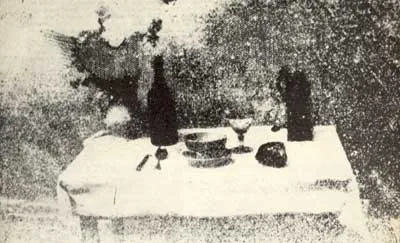
In 1829 Niépce signed a ten-year partnership with Louis Daguerre, a Parisian painter and showman who had heard about his experiments from their shared optician, Charles Chevalier. Together they developed the physautotype, which used the residue of distilled lavender oil on silvered plates. It was faster than bitumen, but still needed hours. Niépce died in 1833; his son Isidore took his place in the partnership. Daguerre kept working, now with silver and iodine, and arrived at a very different process.
In the darkroom
Why does Niépce's view from Le Gras show sunlight on both sides of the courtyard? Move the sun across the sky, then expose a bitumen plate and compare it with a ten-minute daguerreotype.
Scroll slowly: the sun crosses the sky from 9:00 to 17:00 and the plate records the whole day. Afterwards the controls are yours.
Bitumen of Judea is a natural asphalt: a tangle of large carbon-rich molecules, soluble in oil of lavender. Ultraviolet and blue light make neighbouring molecules join up (cross-link) into a network that no longer dissolves. Exposure has to go on for hours because bitumen is extremely insensitive.
After exposure, Niépce washed the plate with lavender oil and white petroleum. Soft, unexposed bitumen dissolved and exposed bare pewter; the hardened bitumen stayed as a pale film. Pale bitumen on dark metal gives a positive image with no developing and no negative.
In this simplified model the window looks north, so the sun travels from the right-hand side of the view in the morning, behind the camera at midday, to the left in the evening. Over an exposure of eight hours or more, the west-facing and east-facing walls each get their turn in the sun, and the plate records both. A daguerreotype exposed for minutes catches the shadows of a single moment. Read about Niépce →
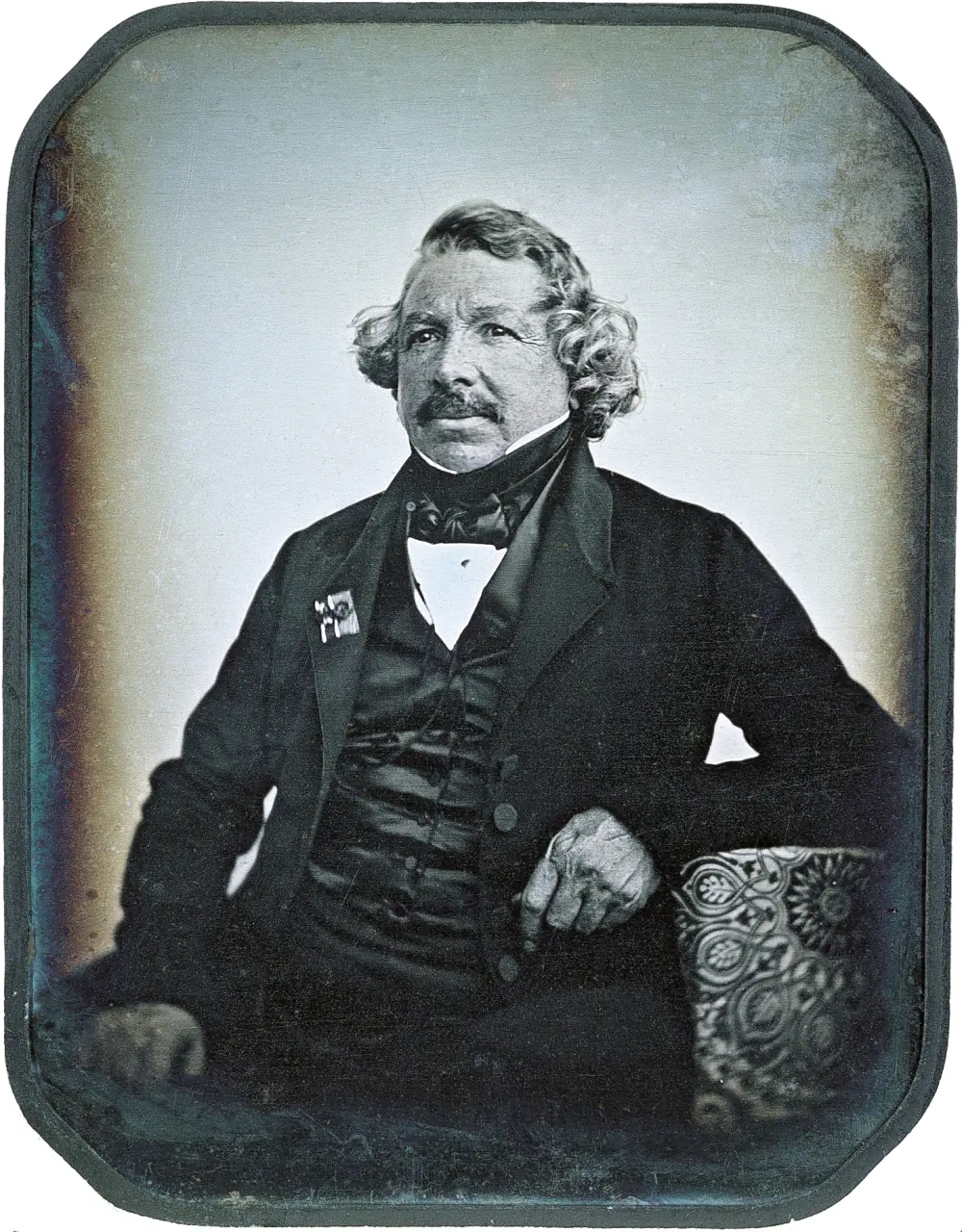
Before he was a photographer, Daguerre was Paris's most celebrated illusionist. His Diorama ran for seventeen years, and it trained him in exactly the problem photography would solve: how light behaves on a surface.
Louis-Jacques-Mandé Daguerre (1787–1851) trained under the panorama painter Pierre Prévost and made his name designing stage effects for the Ambigu-Comique and the Opéra, where his moonlight and sunrise effects drew reviews of their own. In 1822, with the architectural painter Charles-Marie Bouton, he opened the Diorama in a purpose-built hall on the rue Sanson, near the Château-d'Eau in Paris (the site of today's Place de la République).
The audience, roughly 350 people, sat in a darkened, circular auditorium that could be turned on a pivot to face one of two or three stages in turn. Each stage was seen down a long, dark tunnel that hid its edges, so there was nothing to judge its size against. At the far end hung an enormous painting, around 22 by 14 metres, on semi-transparent linen or calico.
The trick was in the lighting. Skylights and windows above and behind the picture were fitted with blinds, shutters and coloured screens worked by stagehands. Light from the front showed the image painted on the front of the canvas. As it dimmed and light was let in from behind, a second image, painted on the reverse, shone through: day turned to dusk, empty church naves filled with worshippers at midnight mass, snow fell, an Alpine valley was buried by a landslide. A show lasted about fifteen minutes per picture.
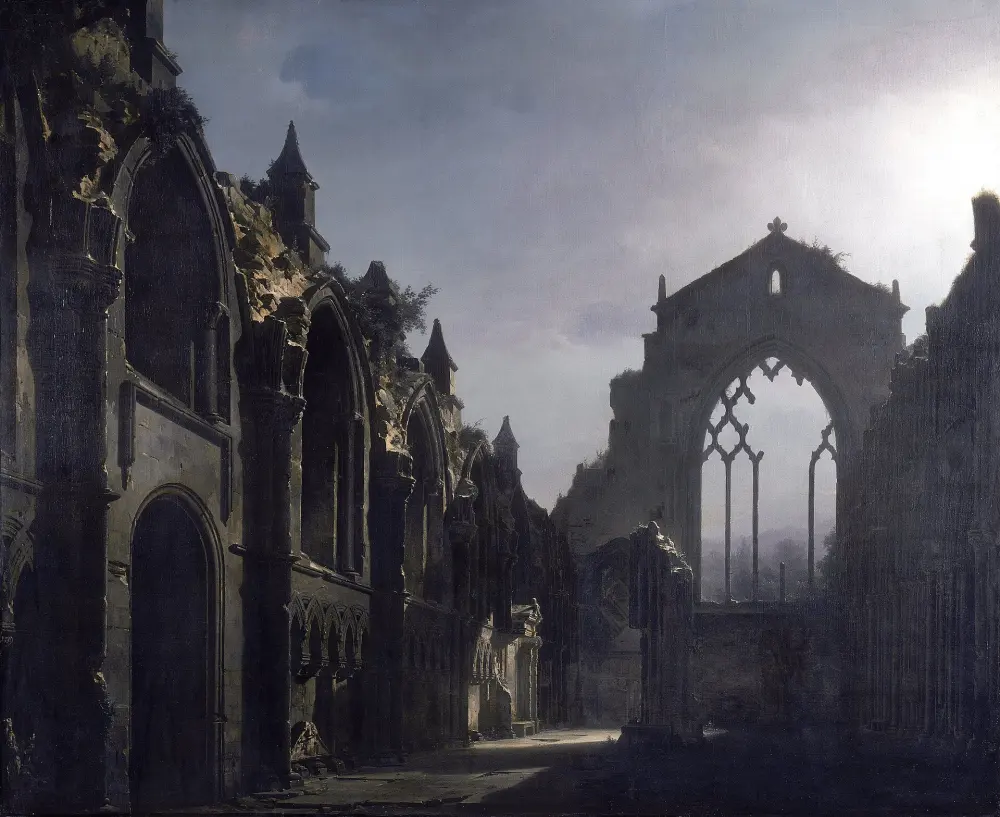
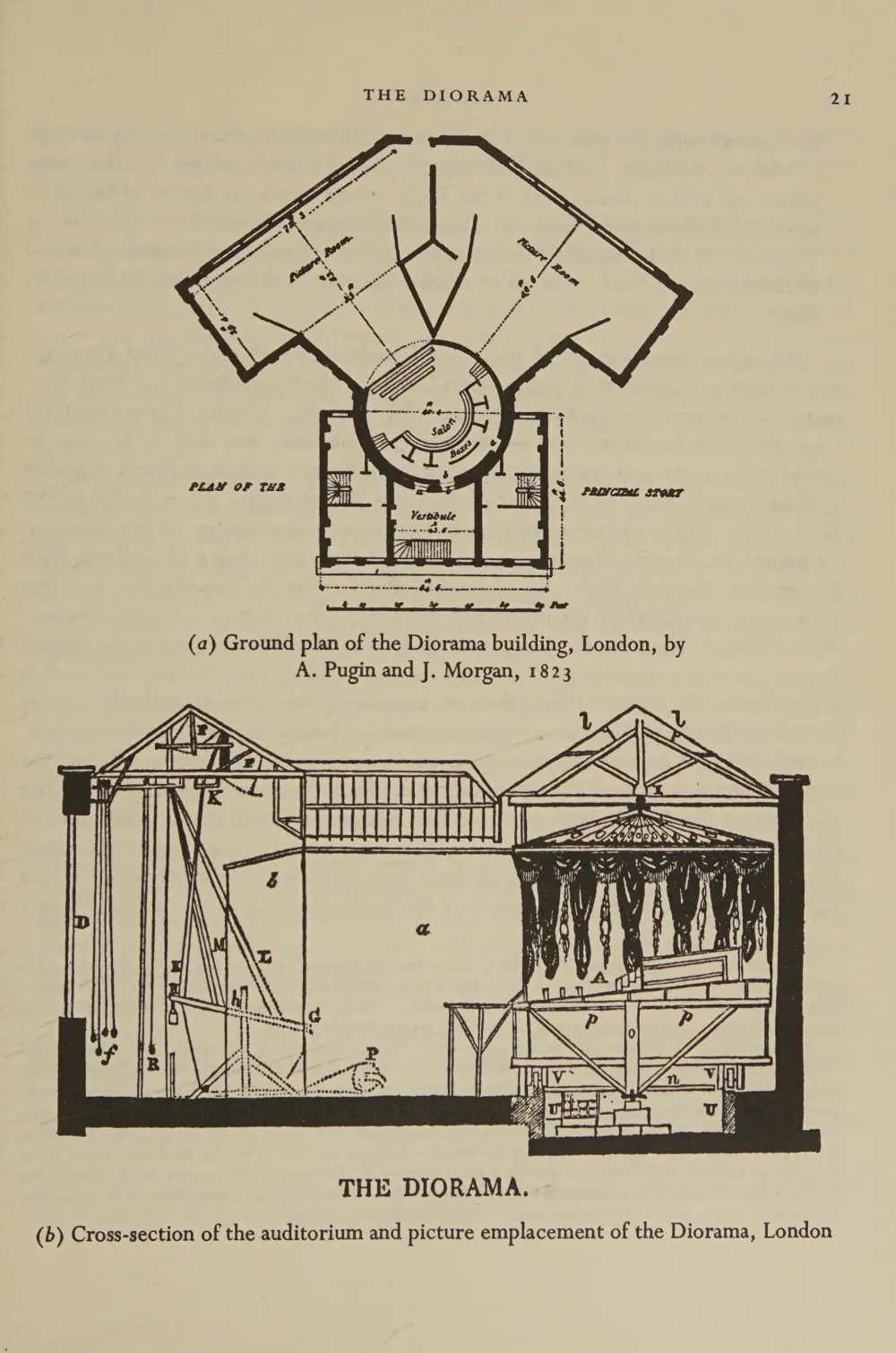
A second Diorama opened in Regent's Park, London, in September 1823, in a building designed by Augustus Charles Pugin and James Morgan behind John Nash's Park Square East terrace. It showed Daguerre and Bouton's pictures, among them Canterbury Cathedral, the Valley of Sarnen and Holyrood Chapel by moonlight. The façade still stands. Imitations followed in Berlin, Edinburgh, Liverpool, Manchester and Dublin.
Daguerre lived and worked in the Paris Diorama building, and it was there that he carried on the experiments that became the daguerreotype. On 8 March 1839, two months after his invention was announced, the Diorama burned down, taking his paintings with it.
The only Daguerre diorama to survive is a smaller one he painted in 1842 for the parish church at Bry-sur-Marne, where he had retired: a trompe-l'œil Gothic choir behind the altar, restored in the 2010s and still lit by daylight.
The Diorama was a machine for controlling light falling on a picture: dimming it, colouring it, changing its direction to reveal one image and hide another. Daguerre used a camera obscura to make preparatory studies for his huge canvases, and he wanted an automatic way of recording what it showed.
His famous 1839 manual even put the two inventions side by side: Historique et description des procédés du daguerréotype et du diorama. To contemporaries, the daguerreotype looked like the work of a man who had spent his career manufacturing realism, which is exactly what it was.
In the darkroom
The same canvas, two pictures: light from the front shows one, light from behind shows another. Daguerre's Diorama mixed them to turn day into night in front of a seated audience.
Scroll to close the skylight blinds and open the rear shutters, as the Diorama stagehands did.
Paint seen by light from the front is seen by reflection: we see whatever colours the pigments send back. The same canvas lit only from behind is seen by transmission: thin, transparent washes let light through, while thicker or opaque paint blocks it and reads as dark shapes. Daguerre painted the daytime scene on the front of semi-transparent calico or linen and the night details (lit windows, a moon, figures) on the back.
Stagehands worked blinds, shutters and coloured screens above and behind the canvas, so the balance of front and back light could shift over minutes. The audience never saw the canvas edges or the light sources. It was a training in exactly what photography needed: knowing how light falling on a surface becomes an image. Read the story of the Diorama →
The daguerreotype made photography a public sensation: astonishingly detailed portraits and city views, held on a polished silver surface.
The daguerreotype used a highly polished, silver-plated copper plate. Iodine vapour made the surface light-sensitive. After exposure, an invisible latent image was brought out over heated mercury vapour, then fixed (at first with hot salt water, soon with Herschel's hypo) and washed. Daguerre's key discovery, around 1835, was that development could reveal an image after a short exposure, instead of waiting for light to do all the work.
The result was a unique object: depending on the angle, it looks positive or negative, like a mirror with a memory. It was also laterally reversed, as a mirror is.
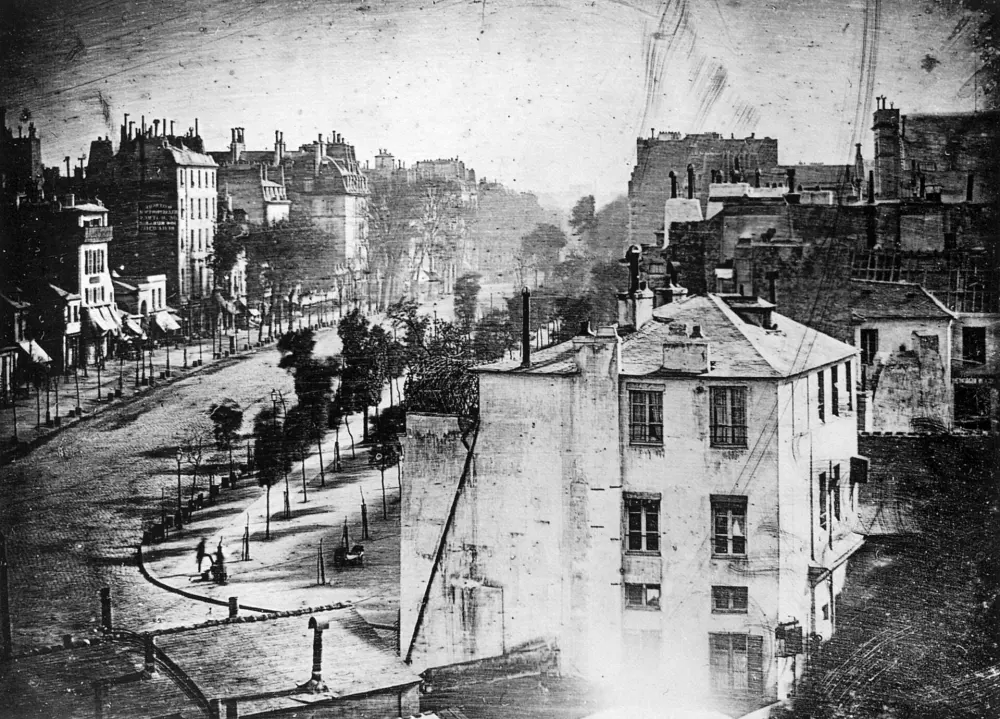
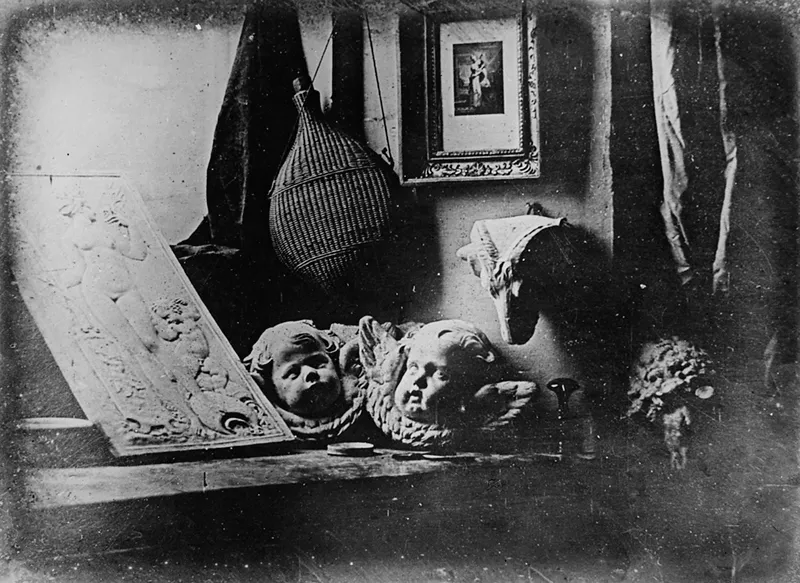
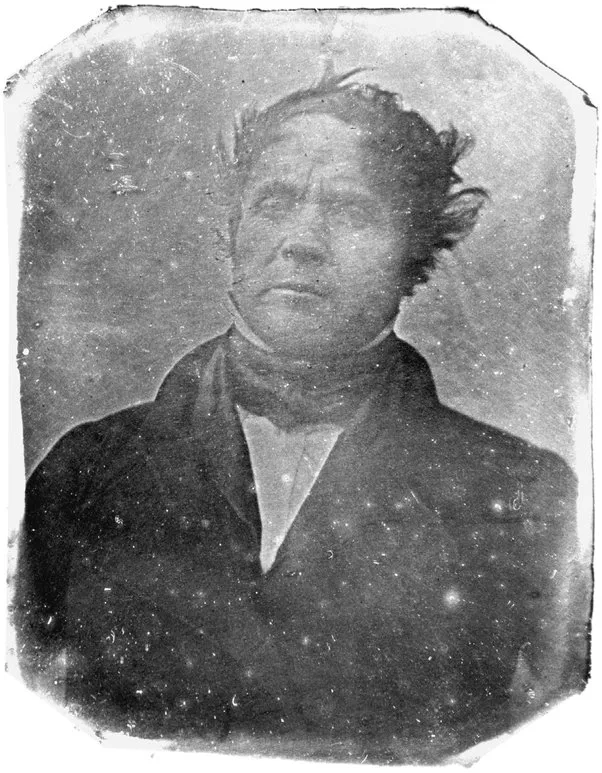
Daguerre's earliest reliably dated plate, from 1837, is a still life of plaster casts in his studio. A portrait inscribed "M. Huet 1837", if genuine, would be the oldest photograph of a person. The best known early plate, of the Boulevard du Temple, was made in spring 1838 from a window high above the street. The exposure was several minutes, so moving traffic left no trace. The exception is a man standing still to have his boots polished, the first people known to appear in a photograph.
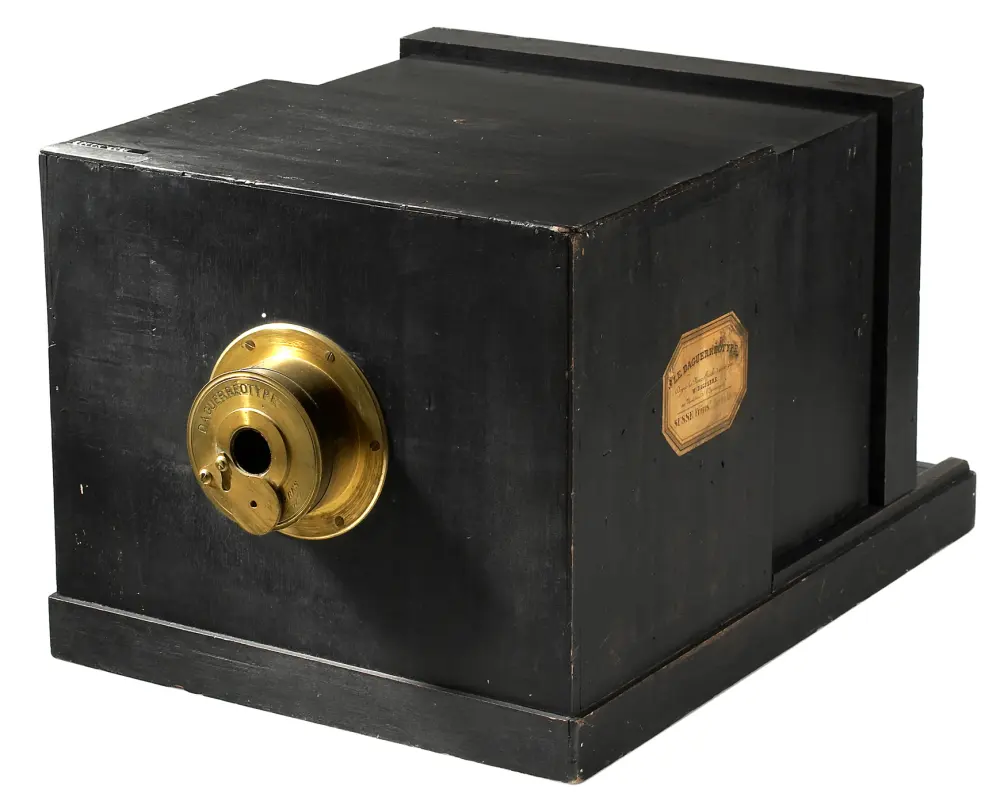
A silver-plated copper plate is buffed to a mirror finish.
Iodine vapour forms light-sensitive silver iodide.
Light creates a latent image, revealed with mercury vapour.
Unexposed salts are removed; the plate is washed and sealed under glass.
On 7 January 1839 the astronomer and politician François Arago announced the invention to the Académie des sciences, without saying how it worked. The French state bought the rights, granting pensions to Daguerre and to Isidore Niépce, and on 19 August 1839 the full method was described to a joint meeting of the academies of sciences and fine arts. It was presented as France's gift to the world, though five days earlier Daguerre's agent had quietly patented it in England and Wales. Within weeks his manual was in print in several languages, and Paris was gripped by what cartoonists called daguerréotypomanie.
The first plates needed minutes in bright sun, too long for comfortable portraits. In 1840 Joseph Petzval's fast portrait lens and new "accelerating" chemicals such as bromine cut exposures to seconds. Commercial studios opened in New York in 1840 and London in 1841, and within a decade millions of daguerreotype portraits had been made.
In the darkroom
A daguerreotype is a polished silver mirror carrying an image made of microscopic white particles. Whether you see a positive or a negative depends on what the mirror happens to reflect. Tilt the plate.
Scroll to tilt the plate away from the dark velvet and towards the window. Afterwards, use the slider.
The plate is silver, polished like a mirror and made sensitive with iodine vapour, which forms a thin film of silver iodide. Light in the camera leaves invisible specks of metallic silver. Daguerre then held the plate face-down over a dish of gently heated mercury. Mercury vapour condenses only on the specks, growing tiny droplets of silver–mercury amalgam about a thousandth of a millimetre across. Hypo or salt water dissolves the remaining silver iodide.
The amalgam particles are rough and pale: they scatter light in all directions, so they look white from every angle. The bare silver between them reflects like a mirror. Highlights are particles; shadows are mirror.
Hold the plate so that it reflects something dark, such as a black velvet case lining or your own dark clothing, and the mirror areas read as shadows: a positive. Let it reflect a bright window and the mirror areas outshine the particles: a negative. Somewhere in between the two match and the image vanishes. That's why daguerreotypes came in hinged cases lined with dark velvet. The surface is so delicate a fingertip can wipe it away, so plates were sealed under glass; from 1840, gilding with gold chloride (Fizeau's method) made them warmer and tougher.
Oliver Wendell Holmes called the daguerreotype "the mirror with a memory" in 1859. Read about Daguerre →
In England, a mathematician and botanist working alone at Lacock Abbey arrived at the idea that would shape the next 150 years: a negative from which any number of positives could be printed.
William Henry Fox Talbot (1800–1877) began experimenting in 1834, soon after his Como frustration. He soaked writing paper in weak salt solution, brushed it with silver nitrate, and found that strong salt solution (later potassium iodide) slowed further darkening. Laying leaves, lace and feathers on the paper in sunlight gave crisp white silhouettes on a lilac-brown ground. He called these photogenic drawings.
He also loaded sensitive paper into tiny wooden cameras that his wife Constance called "mousetraps", left around the grounds of Lacock Abbey in Wiltshire. In August 1835 one of them recorded the oriel window of the abbey's south gallery: a negative about an inch across, the oldest camera negative to survive. Talbot noted that the 200 or so panes could be counted with a magnifying glass.
Then he put the work aside. News of Daguerre's announcement in January 1839 sent him rushing: on 25 January he showed photogenic drawings at the Royal Institution, and on 31 January read Some Account of the Art of Photogenic Drawing to the Royal Society. Neither party yet knew how different the two processes were.
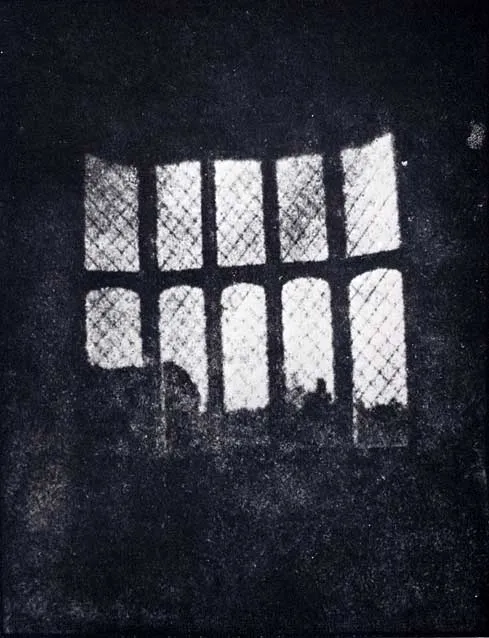
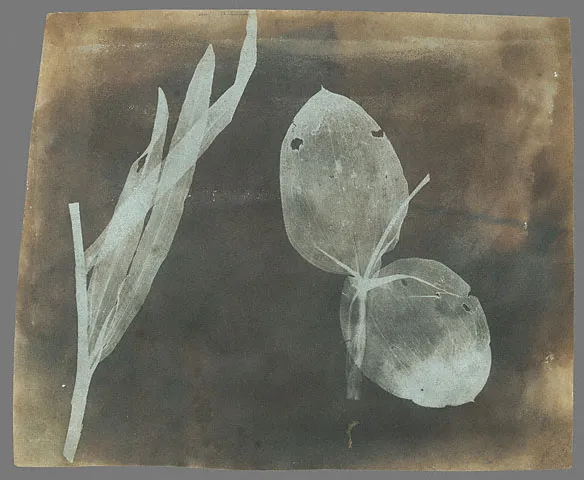
In September 1840 Talbot found what Daguerre had found: a brief exposure leaves an invisible latent image that can be developed chemically, here with gallic acid and silver nitrate. Exposures fell from many minutes to seconds. He called the improved process the calotype (from Greek kalos, beautiful) and patented it in February 1841. Waxed paper negatives were contact-printed onto salted paper to make positives, as many as were needed.
Calotypes were softer than daguerreotypes; the paper fibres blurred fine detail. But they could be multiplied, pasted into books and mailed. Talbot set up a printing works at Reading with his former valet Nicolaas Henneman, and between 1844 and 1846 issued The Pencil of Nature in six parts with 24 tipped-in photographs: buildings, books, a haystack, a ladder, an open stable door, shelves of china. It was the first commercially published book illustrated with photographs, and an argument for everything the medium could do, from recording and copying to making pictures for their own sake.
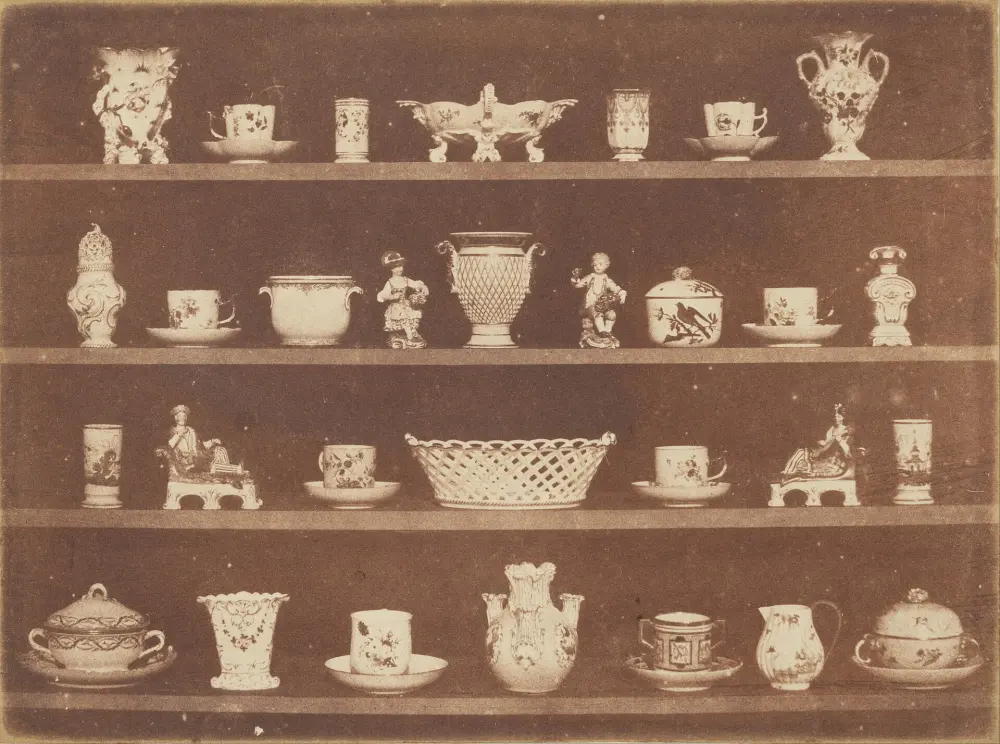
Writing paper is coated with silver iodide and gallo-nitrate of silver.
A short exposure in the camera forms a latent image.
Gallic acid reveals a negative; hypo fixes it; wax makes it translucent.
The negative is laid on salted paper in sunlight: positives, again and again.
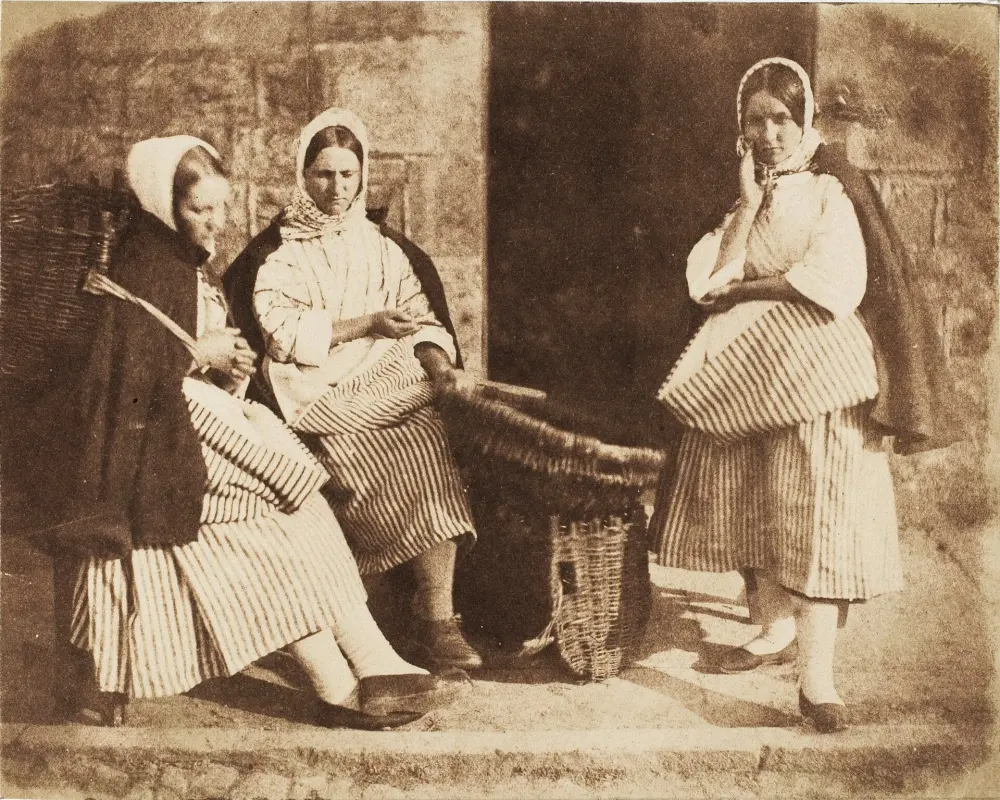
Talbot's patents were strictly enforced in England and Wales, which slowed the calotype there. They did not extend to Scotland. In Edinburgh, Talbot's friend Sir David Brewster encouraged its use, and from 1843 the painter David Octavius Hill and the young chemist Robert Adamson made some 3,000 calotypes at Rock House on Calton Hill. They began with reference portraits for Hill's vast painting of the founding of the Free Church of Scotland, with 474 figures, and went on to the fisherfolk of Newhaven, among the first sustained documentary series in photography.
In the darkroom
Talbot's great idea: lay a negative on a second sheet and let the sun print through it. The tones reverse again, and you can repeat it as often as you like.
Where the negative is dark (where light fell on the original sheet), little light passes and the print stays pale. Where the negative is clear, the print darkens. Tones reverse twice, so the print matches the world. Talbot made the negative translucent by waxing it, and printed on salted paper in sunshine, without developer: the reddish-brown salt print, often toned with gold for permanence.
Because the negative is laid face-to-face on the paper, the print is also its mirror image. For a camera negative, already reversed by the lens, that puts the world the right way round again. For a camera-less photogram of letters, the print reads backwards. If you made a negative in "What light does to silver", it's loaded here; otherwise you'll start with a negative of Talbot's lattice window.
1839 is photography's official birthday, but the invention was simultaneous and scattered. Several people arrived at workable processes independently, and the first years produced a run of firsts.
In the village of São Carlos (now Campinas), the French-born painter Hércules Florence wanted a way to print labels and diplomas in a country with almost no presses. In 1833 he made contact copies on silver-salt paper, fixed them with ammonia, and in his notes called the process photographie, years before the word was used in Europe. His work stayed unknown until the historian Boris Kossoy examined his manuscripts in the 1970s.
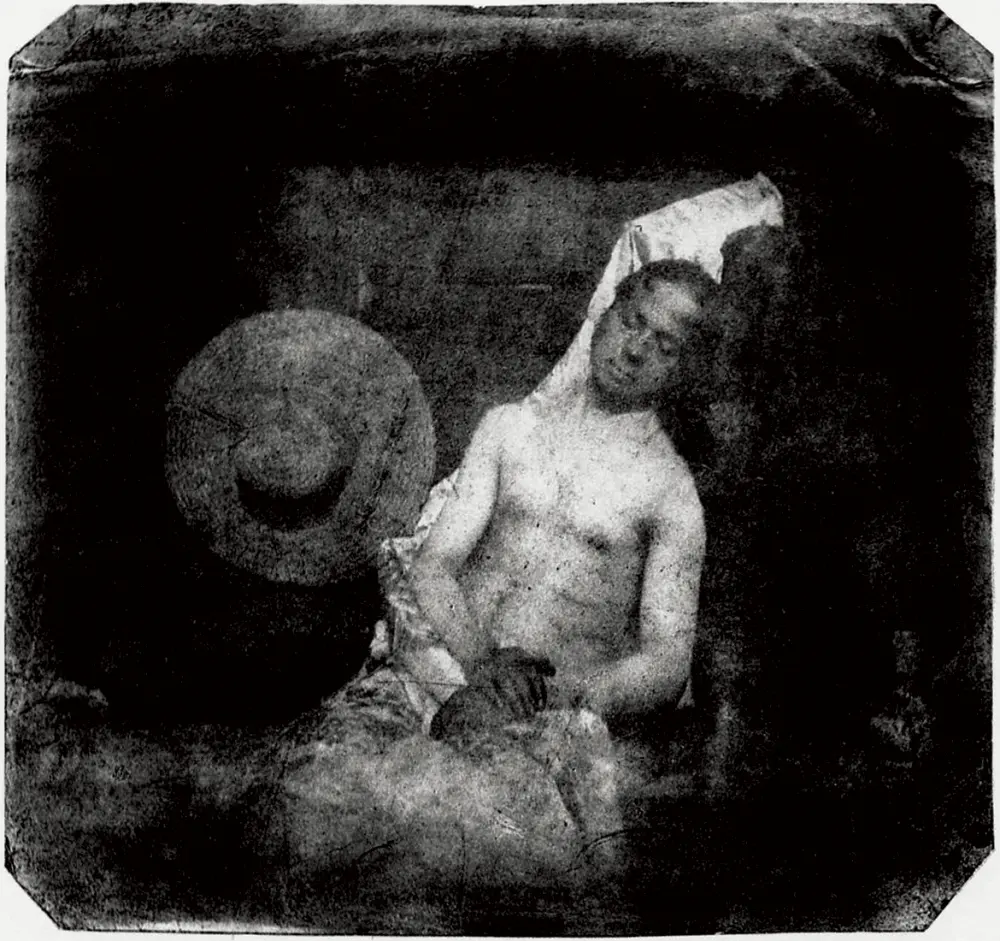
Hippolyte Bayard, a clerk at the Ministry of Finance, invented a direct positive paper process in early 1839 and on 24 June showed some thirty prints at a charity sale in Paris, arguably the first public exhibition of photographs. Arago, Daguerre's champion, persuaded him to delay publishing. Bayard got a small grant; Daguerre got the glory. In October 1840 Bayard staged a protest: a photograph of himself slumped as a drowned man, with a bitter note on the back explaining that the inventor had killed himself after being ignored by the government. It is often called the first staged photograph, and the first photographic hoax.
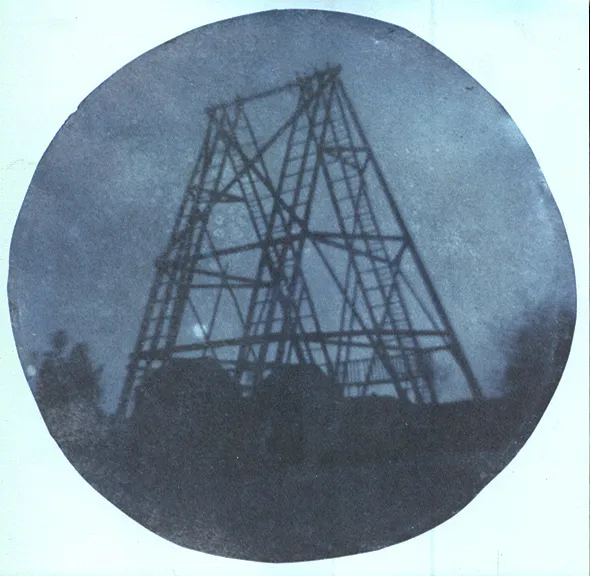
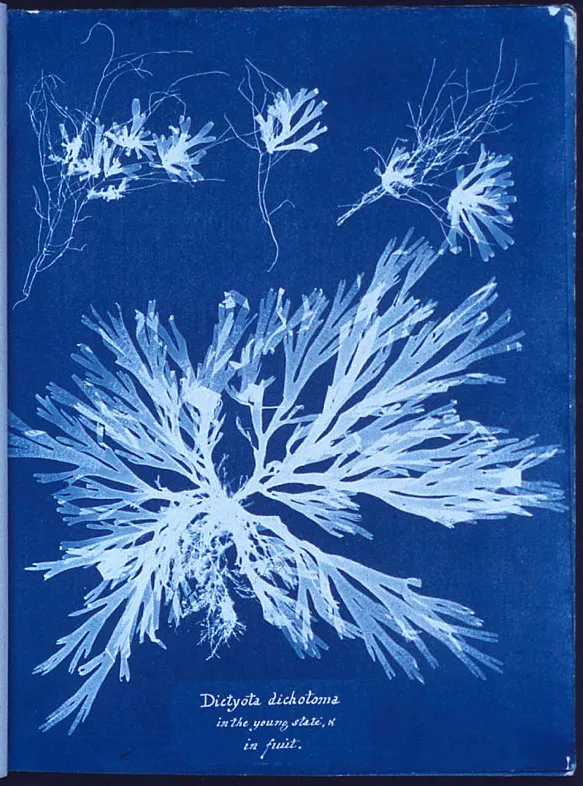
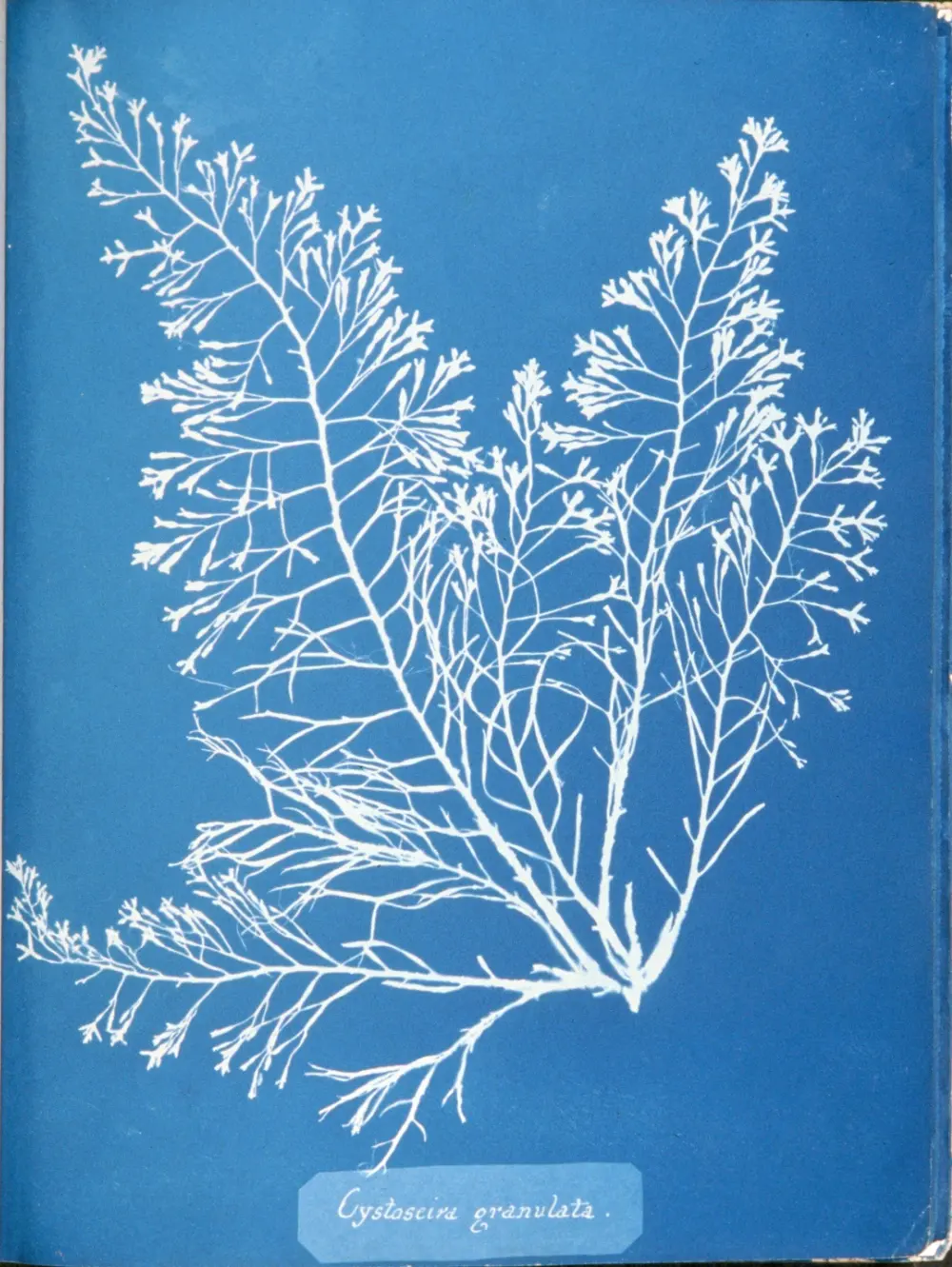
Herschel kept experimenting with every light-sensitive substance he could find. In 1842 he published the cyanotype, which uses iron salts rather than silver and produces a durable Prussian blue. Architects later used it for their "blueprints". His friend Anna Atkins, a botanist and illustrator, used it to make contact images of seaweeds. Beginning in October 1843 she issued Photographs of British Algae: Cyanotype Impressions in parts to a small circle of friends. It is generally recognised as the first book illustrated with photographs, preceding Talbot's, and Atkins as the first woman to make photographs.
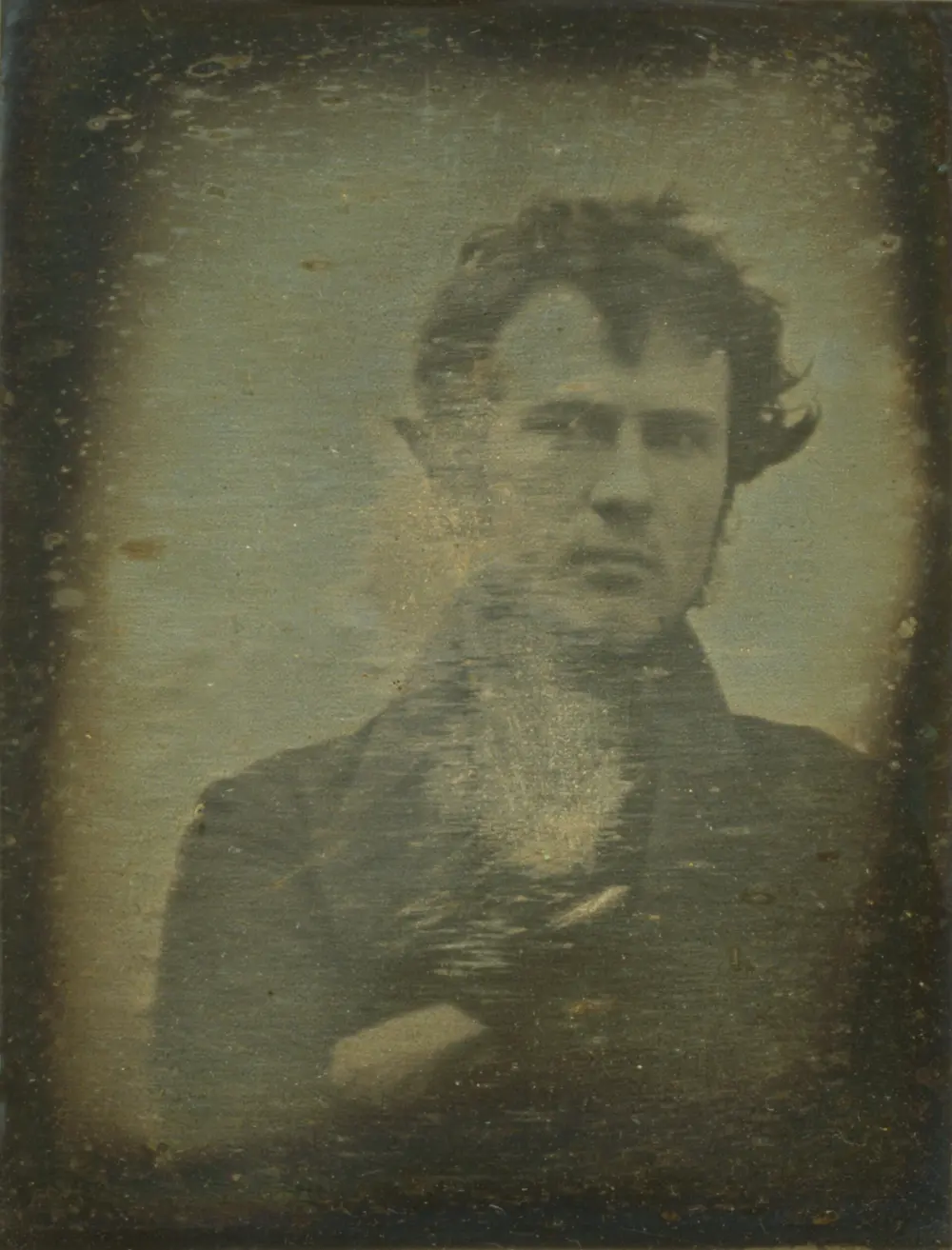
First people in a photograph: the Boulevard du Temple, 1838. First photographic exhibition: Bayard, June 1839. First surviving photograph on glass: Herschel, September 1839. Earliest American portrait: Cornelius, autumn 1839. First portrait studio: Alexander Wolcott and John Johnson, New York, 1840. First staged photograph: Bayard, 1840. First photographically illustrated book: Atkins, 1843.
"First" is slippery in photographic history: claims depend on what survives, what counts as a photograph, and who published. The dates above are the ones most historians accept.
The surviving early photographs in chronological order, from Niépce's heliographs to the first digital scan. Click any image to enlarge it.
Keep scrolling: the photographs slide past in date order.
The first processes were slow, costly and technically demanding. Over the next century and a half photography became reproducible, portable, instantaneous, coloured and finally digital.
In 1850 Louis-Désiré Blanquart-Evrard introduced albumen paper, coated with egg white, which gave sharper, glossier prints and dominated for forty years. In 1851 Frederick Scott Archer published the wet collodion process: glass negatives with the sharpness of a daguerreotype and the reproducibility of a calotype, but the plate had to be coated, exposed and developed before the plate dried. Photographers hauled darkroom tents across battlefields and mountains. Collodion also gave cheap one-off formats: the ambrotype on glass (1854) and the tintype on iron (1856).
André-Adolphe-Eugène Disdéri's carte de visite (1854) put eight small portraits on one plate and launched a collecting craze. Stereoscopic views, popularised by Sir David Brewster's lens stereoscope, brought three-dimensional images of distant places into parlours by the million.
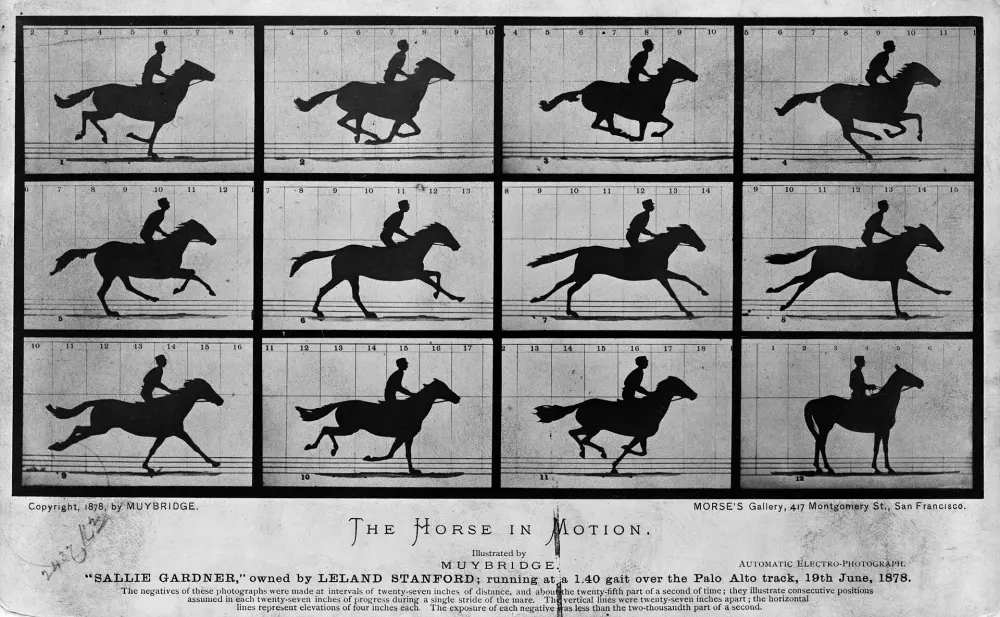
In May 1861 James Clerk Maxwell, with the photographer Thomas Sutton, demonstrated three-colour photography at the Royal Institution: a tartan ribbon photographed through red, green and blue filters and projected through the same filters, one over another. In 1878 Eadweard Muybridge used a row of cameras triggered by threads to show that a galloping horse lifts all four hooves off the ground, and in doing so opened the way to cinema.
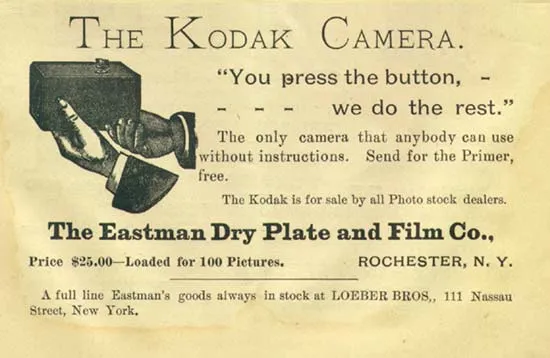
Richard Leach Maddox's gelatin dry plate (1871), made commercially from the late 1870s, could be bought ready-made and developed later; exposures fell to fractions of a second. Halftone screens, first used in a newspaper in 1880, let photographs be printed alongside type. George Eastman's roll film and the Kodak camera (1888) completed the shift: the buyer took a hundred pictures and posted the whole camera back to Rochester for processing. "You press the button, we do the rest." The one-dollar Brownie followed in 1900.
Gabriel Lippmann's interference colour process won a Nobel Prize in 1908; the Lumière brothers' Autochrome, marketed from 1907, made colour practical for enthusiasts, using dyed potato-starch grains as filters. The Leica (1925) popularised 35mm film; Kodachrome (1935) made colour transparencies routine; Edwin Land's Polaroid (1948) delivered a print in a minute. Photojournalism, family snapshots, fashion and advertising each developed their own languages. Photography stopped being a record of exceptional things and became part of everyday life.
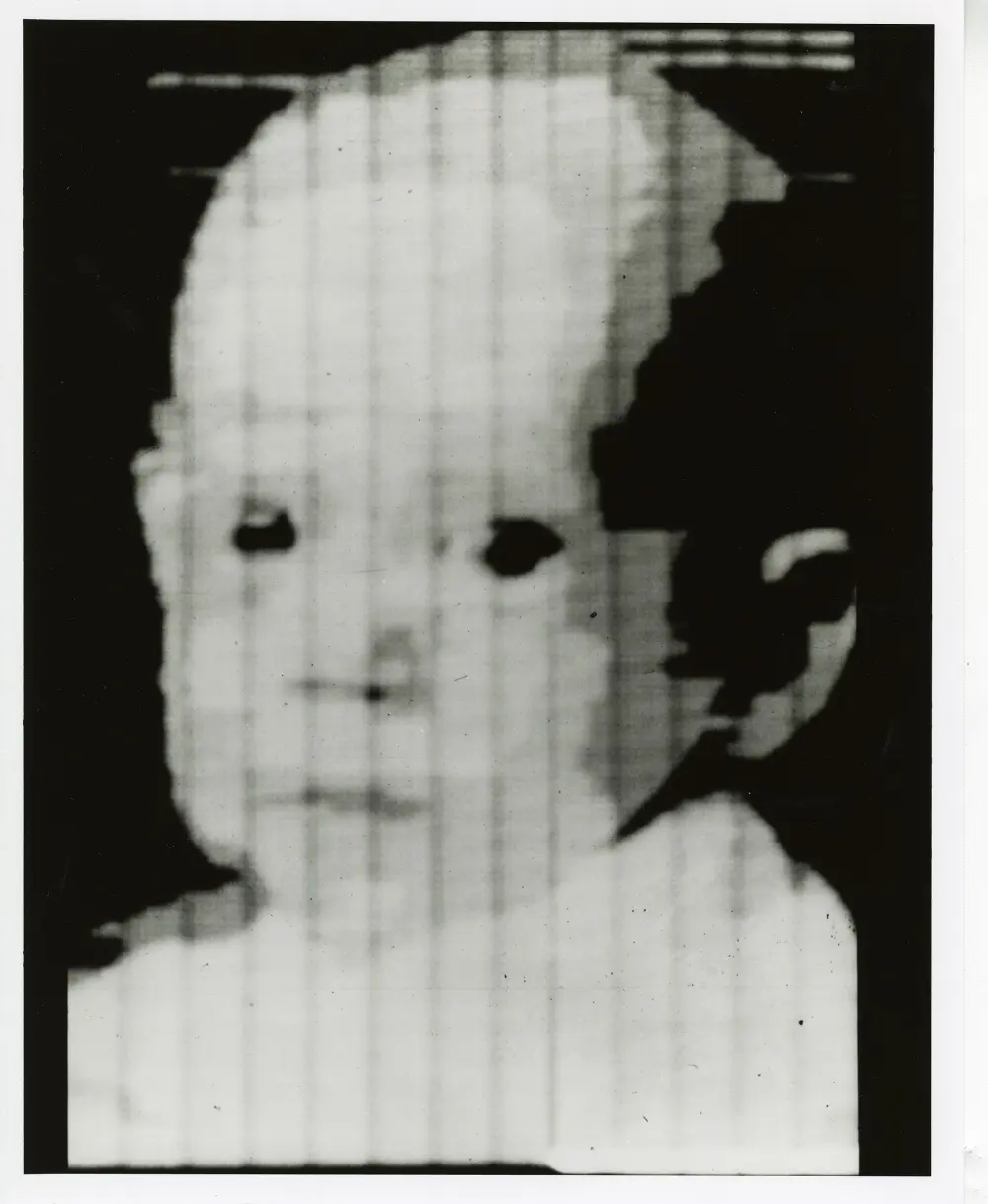
In 1957 Russell Kirsch and colleagues at the US National Bureau of Standards built a drum scanner for the SEAC computer and digitised a 5 cm snapshot of his three-month-old son, Walden, as a grid of 176 × 176 pixels. The charge-coupled device (CCD), invented at Bell Labs in 1969, became the electronic sensor; in 1975 Steven Sasson at Kodak built a self-contained digital camera that took 23 seconds to record a 0.01-megapixel image to cassette tape. Bryce Bayer's colour filter mosaic (1976), the JPEG standard (1992) and the first camera phones (2000) followed.
By the 2010s more photographs were made each year than in the whole of the film era. Today computational photography merges many exposures into one, and generative systems produce photographic-looking images without any light from the scene at all. That unsettles the old assumption that a photograph is a trace of something that stood before a lens.
From the beginning photography was both evidence and performance. Niépce's plate shows a courtyard lit from both sides at once; Gernsheim's famous version of it is retouched; the Boulevard du Temple empties a busy street; Bayard staged his own death within a year of the announcement. The camera records light, but a person chooses where to stand, when to expose, what to include and what to leave out. Processes shape the result, and institutions decide which images survive. Its history belongs to machines and chemistry, and just as much to the people who chose what to look at and what to keep.
A selective timeline of the ideas, processes and technologies that changed what photographs could do.
Early observations of light through a small opening.
Experimental work on light and vision gives the camera obscura a systematic explanation.
Showing the solar eclipse of January 1544.
A lens is added; the device becomes a spectacle and drawing aid, and gets its name.
Silver compounds darken under light, not heat.
Ammonia dissolves the unexposed salt.
Shadow images on paper and leather that darken away.
A prism drawing aid later used by Talbot.
His camera images on silver chloride paper cannot be fixed.
The future fixer, twenty years early.
Niépce's first heliographic copy (later destroyed); Daguerre and Bouton open the Diorama in Paris in July.
The building still stands at Park Square East.
Niépce's boy leading a horse and woman at a spinning wheel.
The oldest surviving camera photograph; Cardinal d'Amboise plates printed.
Leading to the physautotype; Niépce dies in 1833.
An independent paper process, unknown in Europe.
The oldest surviving camera negative.
The studio still life; the Boulevard du Temple with its first human figures.
7 Jan: Arago announces the daguerreotype. 25–31 Jan: Talbot shows photogenic drawing. 8 Mar: Diorama burns. 24 Jun: Bayard exhibits. 19 Aug: daguerreotype method published. 9 Sep: Herschel's glass negative. Autumn: Cornelius self-portrait.
Exposures drop to seconds; portrait studio opens in New York. Bayard's Drowned Man.
Developed paper negatives; Richard Beard opens London's first studio.
Herschel's iron-based process; Anna Atkins begins Photographs of British Algae.
Around 3,000 calotypes, including the Newhaven series.
Talbot's commercially published photographic book, in six parts.
Sharp glass negatives and glossy prints.
Disdéri's cheap multiple portraits create a mass market.
The tartan ribbon, with Thomas Sutton.
Fast, factory-made plates; motion stopped in fractions of a second.
Photographs printed with type.
Roll film and a simple camera bring photography to a mass audience.
Colour photography becomes commercially available.
35mm film and a mobile, immediate style of picture-making.
Practical colour film; instant prints.
Russell Kirsch's 176 × 176 pixel image of his son.
Boyle and Smith at Bell Labs; Steven Sasson at Kodak.
Photography becomes networked and constant.
Multi-frame processing and image synthesis reshape what a photograph is.
Some of the people whose work turned a curious optical effect into a global medium.
Optics · 11th century
Scientist whose experiments on light, vision and the camera obscura shaped the history of optics.
Camera obscura · 1545
Mathematician who published the first picture of a camera obscura, used to watch an eclipse.
Photochemistry · 1727
Showed that silver compounds darken through the action of light.
Photograms · c. 1800
Made early shadow images on sensitised paper and leather with Humphry Davy.
Heliography · 1820s
Turned lithographic ambitions into the first permanent photographs and photo-etched printing plates.
Diorama · Daguerreotype
Showman of light whose Diorama led to the detailed direct-positive process that made photography famous.
Diorama · 1822
Architectural painter and Daguerre's partner in the Diorama; painted many of its church interiors.
Calotype · 1841
Invented the negative–positive paper process and the first commercial photobook.
Fixing · Cyanotype
Gave photography hypo, the cyanotype, the first glass negative and much of its vocabulary.
Direct positive · 1839
Independent inventor who held the first exhibition and staged the first photographic protest.
Photographie · 1833
Invented a photographic process in isolation in Brazil and named it before anyone in Europe.
Cyanotype book · 1843
Botanist who produced the first book illustrated with photographs.
Calotype · 1843–47
Edinburgh partnership whose portraits and Newhaven studies set an early standard for documentary work.
Wet collodion · 1851
Published the glass-plate process that dominated photography for thirty years, and never patented it.
Colour · 1861
Demonstrated the three-colour principle behind almost all colour imaging.
Motion · 1878
Used banks of cameras to stop motion, anticipating cinema.
Kodak · 1888
Made photography a consumer activity with roll film and processing by post.
Digital · 1957
Led the team that scanned the first photograph into a computer.
The history is still being researched and reinterpreted. These collections are good starting points for seeing original objects.
All photographs and historical illustrations on this page come from Wikimedia Commons and are in the public domain (or, for the modern photographs of museum objects and the camera lucida, freely licensed; see each file page through the Commons links). Diagrams and the Diorama simulation are original schematic drawings. Copies are stored with this page, so it does not depend on Commons being reachable.